


Understanding the Air–Land–Water Connection
Our science doesn’t stop at the lake’s surface. Atmospheric research is a vital part of understanding how Lake Tahoe and ecosystems across California function and change.
Our Atmospheric Research team studies the dynamic exchange between air, land, and water — how the atmosphere shapes conditions at Earth’s surface, and how those surfaces, in turn, influence the atmosphere.
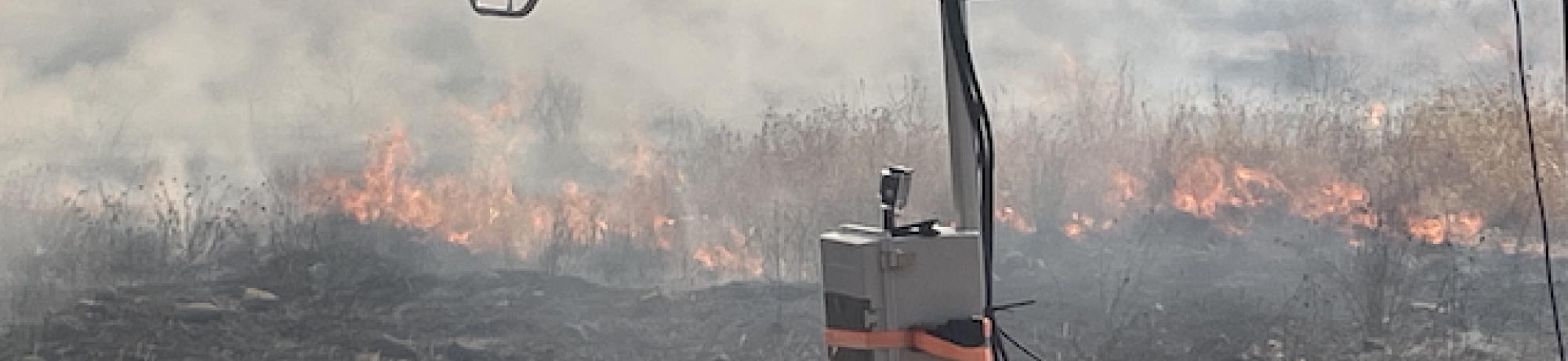
These exchanges of heat, water vapor, carbon dioxide, methane, and energy — measured using advanced sensor systems called flux towers — shape local climate, ecosystem health, wildfire behavior, and water resources.
Research Across California
The team’s work spans diverse landscapes, each offering insight into land–water–atmosphere dynamics.
Bay Area Reservoirs
Working with reservoir operators and TERC scientists, the team combines atmospheric measurements with in-lake instrumentation to determine when and how methane is released. This research helps managers better understand and reduce greenhouse gas emissions.
Coastal Redwoods, Mendocino County
In partnership with CNRA, CalFire, Lawrence Berkeley National Laboratory, and UC Davis collaborators, 200-foot flux towers monitor microclimate conditions and ecosystem use of water vapor and CO₂. These rare datasets support wildfire mitigation strategies and long-term carbon storage in redwood forests.
Vacaville Almond Orchards
Collaborating with the USDA, the team uses flux towers and Doppler LiDAR to study how warm, dry winds interact with irrigated agricultural lands. This research improves satellite-based models of evapotranspiration and soil moisture — critical tools for water management across the West.
French Meadows Reservoir Area, Sierra Nevada
Near the Sierra crest, 170-foot towers measure how sloping terrain influences wind, turbulence, and the fluxes of CO₂, water vapor, and heat throughout the year. The findings improve localized weather prediction, wildfire and smoke-spread forecasting, and the understanding of ecosystem responses to forest management.
Why Atmospheric Research Matters
The atmosphere is the bridge connecting California’s ecosystems — from the coast, across the Central Valley, to the Sierra Nevada and Lake Tahoe.
Understanding turbulent transport and terrain effects directly improves:
- Air-to-lake nutrient and particle deposition models
- Smoke and wildfire spread forecasts
- Ecosystem health assessments
- Carbon and water balance estimates
- Localized weather prediction
- Climate impact modeling on snowmelt and lake conditions
This work shows the sky is not a boundary for our science — it is an essential part of the story.
By integrating atmospheric, terrestrial, and aquatic research, TERC is building a more complete understanding of the systems that shape Lake Tahoe and the broader Sierra Nevada.
For more information, email Holly Oldroyd @ UC Davis.